
Calculate from Speed, not from what remains
If your character has the Prone condition, the 2024 D&D rules let you end it by spending movement equal to half your Speed, rounded down. With a Speed of thirty feet, reserve fifteen to stand. Do not calculate half the movement you happen to have left at that moment.
The official Prone entry also says you cannot right yourself this way if your Speed is zero. Confirm the condition, applicable effects and rules version with your DM before updating the sheet.
Thirty Speed, twenty available
Fictional example: your current Speed is 30 feet, you have already spent 10 movement this turn and the DM confirms you are Prone. With no extra movement or other modifiers in this hypothetical situation, 20 feet remain available.
The cost of standing uses the Speed of 30: 30 ÷ 2 = 15. After paying it, 20 − 15 = 5 feet of movement remain. Not ten: that calculation would have halved the remaining budget instead of using Speed.
We do not change your base Speed to five. Five is the movement remaining in this example after both costs: the earlier ten and fifteen to stand.
What to update on the sheet
DnD Dynamic Sheet documents tracking turn actions and movement, plus notes. For this case, review remaining movement using the amount resolved at the table. The cost described for standing is movement: do not mark an otherwise unused Action merely for paying it.
If your Action was already spent for another reason, standing does not restore it either. Each control should retain what it represents. You can note the calculation if it helps explain why five feet remain.
This is a manual proposal based on the cited rules and the sheet’s documented features. It does not claim the application detects Prone, automatically calculates the cost or decides whether an effect prevents standing.
Before moving the miniature
Check current Speed, remaining movement and whether you can pay the appropriate cost. If another effect changed Speed, do not carry the example’s fifteen feet over as a universal rule. If Speed is zero, consult Prone’s explicit limit rather than writing a negative amount to force the action.
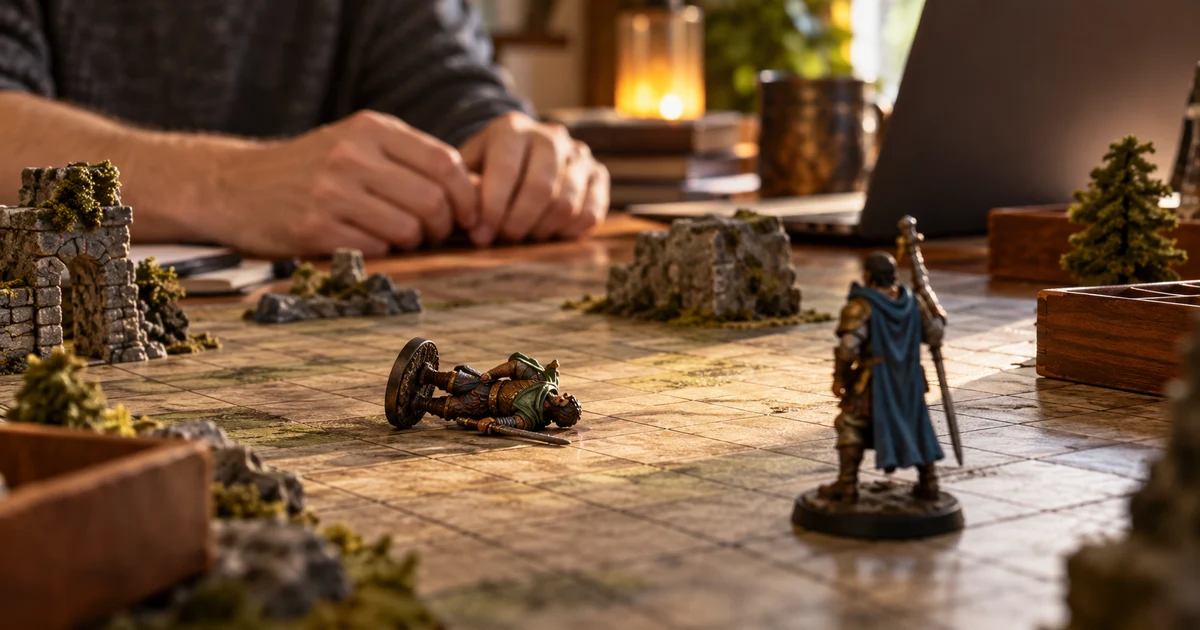
DnD Dynamic Sheet is a paid Windows beta. Review its turn and movement demonstrations to assess the workflow. The cover is a generated tabletop illustration, rather than a screenshot or proof of the calculation inside the application.